
SB9 Duplex Investment Property Tour: 4 Units on One Lot
When most people look at a single-family home, they see a single source of income.
When developers look at the same property, they see potential.
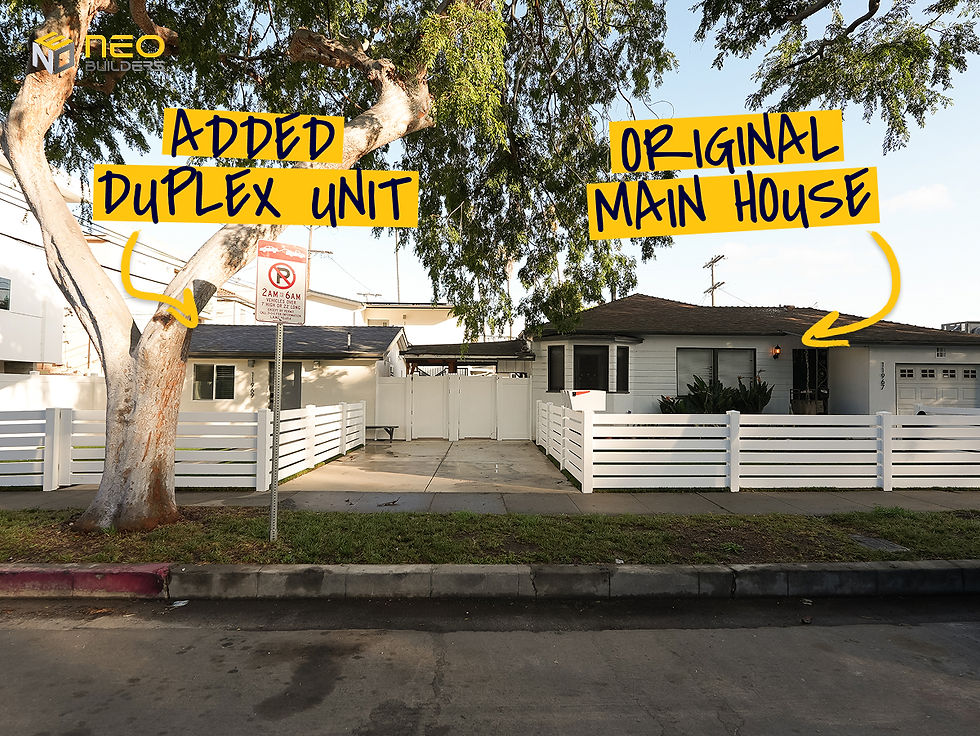
In this project, we transformed a property that originally contained just one home into a four-unit multifamily property using California's SB9 Duplex Provision and ADU laws. What started as a typical single-family residence now consists of the original home, a converted one-bedroom unit, and two newly constructed two-bedroom units.
The result?
More than $15,300 per month in rental income, an estimated 20% cash-on-cash return, and a property value projected to increase by roughly 120% compared to the original acquisition cost.

What's particularly interesting about this project is that we didn't use the SB9 Lot Split Provision, which is the strategy most investors associate with SB9. Instead, we leveraged the Duplex Provision to convert the property into a multifamily property, then used California's multifamily ADU laws to add additional units.
This is exactly the type of infill housing California lawmakers envisioned when passing SB9: creating more housing opportunities within existing neighborhoods without requiring large-scale redevelopment.
In this article, we'll break down how the project was structured, why the property was such a strong candidate for development, the rental income each unit generates, and the lessons investors can apply to their own projects.
If you own a property and are wondering whether it could support additional units, schedule a call with NeoBuilders. Our team can evaluate your site, explain your development options, and help you determine whether an SB9 project makes financial sense for your investment goals.

Project Snapshot
Before we dive into the details, here's a quick overview of the project.

What was once a single-family property is now a four-unit income-producing asset generating more than $11,300 per month in rental income.
Property Overview
Development Strategy: SB9 Duplex Provision + Multifamily ADUs
Lot Type: Corner lot with rear alley access
Original Property: Single-family home with an unpermitted pool house
Final Unit Count: 4 total units
Rental Income: $11,300 per month
Estimated Cash-on-Cash Return: 20%
Estimated Increase in Property Value: Approximately 120%
Unit Breakdown
Original Main House
Existing residence retained on the property
Currently renting for $4,000/month
Pool House Conversion
1 Bedroom / 1 Bathroom
400 sq. ft.
Private fenced yard
Currently renting for $2,500/month
Lower Unit
2 Bedrooms / 2 Bathrooms
800 sq. ft.
Currently renting for $4,300/month
Upper Unit
2 Bedrooms / 2 Bathrooms
800 sq. ft.
12-foot vaulted ceilings
Currently renting for $4,500/month
One of the most impressive aspects of this project is that even after adding three additional housing units, the main house still retains approximately 2,500 square feet of outdoor space. There's still room for a backyard, grass area, trampoline, garage, storage, and outdoor living spaces.
That's what made this property such a strong development opportunity. We were able to dramatically increase density and rental income without making the site feel overcrowded.
What Is the SB9 Duplex Provision?
To understand how this project went from one home to four units, it's important to understand California's SB9 law.
Passed in 2021, SB9 was designed to increase housing density in neighborhoods traditionally zoned for single-family homes. The law created two primary development pathways for qualifying properties: the Lot Split Provision and the Duplex Provision.
The Lot Split Provision allows homeowners and developers to divide a single lot into two separate parcels. Once split, each lot can potentially accommodate additional housing, creating opportunities to sell off land or develop multiple homes.
But that's not the strategy we used here.
Instead, we utilized the SB9 Duplex Provision, which allows a single-family property to be converted into a duplex. Once a property becomes multifamily, California's multifamily ADU laws come into play, allowing additional detached ADUs to be built on the same lot.
Rather than splitting the property, we kept the lot intact and converted the existing pool house into a legal one-bedroom unit. We then constructed a new two-story building containing two additional units where the pool once stood.

The result was a property with:
The original main house
A 1-bedroom, 1-bathroom conversion unit
A 2-bedroom, 2-bathroom lower unit
A 2-bedroom, 2-bathroom upper unit
Four total units on a single lot.
This approach made sense for several reasons. The property already had plenty of space, there was no need to create a separate parcel, and keeping everything on one lot simplified the overall development strategy while still maximizing rental income.
For investors and developers, that's one of the most powerful aspects of SB9. While lot splits can be valuable in the right situation, they're not always necessary. In some cases, the Duplex Provision alone can dramatically increase density, cash flow, and property value, as this project demonstrates.
Why This Property Was Ideal for SB9 Development
Not every property is a good candidate for an SB9 project.
One of the reasons this development was so successful is because the property already possessed several characteristics that made increasing density relatively straightforward.
Corner Lot Advantages
Corner lots are often some of the most desirable development opportunities because they provide additional access, flexibility, and separation between units.

In this case, the corner lot configuration made construction logistics significantly easier. Contractors had more room to work, materials could be delivered more efficiently, and access to the rear of the property was far less restrictive than what you'd typically find on an interior lot.
The additional street frontage also helped create a greater sense of privacy between the various units. Rather than feeling like four homes squeezed onto a single property, the layout allows each unit to feel more independent.
Alley Access Simplified Construction
The property also benefited from rear alley access, which became a major advantage throughout the construction process.

Large deliveries, equipment, and building materials could be brought directly to the rear of the property without disrupting activity at the front of the home. This improved efficiency for the construction team while minimizing inconvenience for both the property owner and neighboring residents.
For developers, alley access is one of those features that may not seem important during acquisition, but can make a substantial difference once construction begins.
A Large Backyard With Untapped Potential
Perhaps the biggest opportunity was the backyard itself.

Prior to development, much of the rear portion of the property was underutilized. There was a pool, an unpermitted pool house, and a large amount of open land that wasn't generating any meaningful return for the owner.
Rather than viewing the backyard as unused space, we viewed it as an opportunity to create additional housing.
The pool house was converted into a legal rental unit, and the area occupied by the pool became the site for the new two-story building containing two additional residences.

What's remarkable is that even after adding three new units, the original home still retains approximately 2,500 square feet of outdoor space. There's still room for a backyard, grass area, trampoline, storage, garage access, and outdoor living amenities.
That's what makes projects like this so compelling from an investment standpoint. We were able to dramatically increase the property's income potential without sacrificing the usability of the original home.
From One House to Four Units
The real story of this project isn't the construction itself. It's how multiple development strategies were layered together to maximize the property's income potential.
By combining an existing residence, a conversion unit, and two newly constructed units, we were able to transform a traditional single-family property into a four-unit multifamily asset.
The Original Main House
At the front of the property sits the original residence, which remains an important part of the property's overall income strategy.

Rather than demolishing or significantly altering the home, it was preserved and is currently rented to a family member. This allowed the property owner to retain a valuable housing asset while simultaneously increasing the property's rental income through strategic development of the underutilized backyard.
This highlights one of the key advantages of SB9 development. The goal isn't always to replace what's already there. In many cases, the most profitable approach is to preserve existing housing and add density around it.
By maintaining the original residence, converting the pool house, and constructing two additional units, the property owner was able to transform a traditional single-family lot into a four-unit income-producing asset without sacrificing the value of the existing home.
Today, the main house rents for $4,000 per month.
Unit #2: Converting an Unpermitted Pool House Into a Rental Unit
Next to the main house was an existing pool house that had been built without permits.

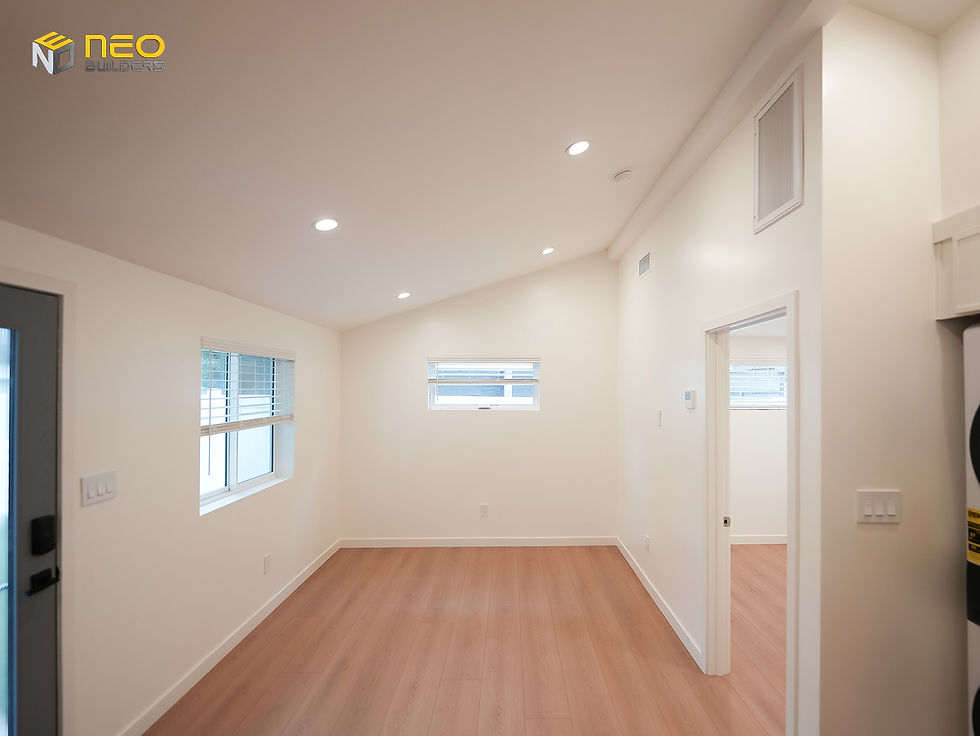
Rather than demolishing the structure entirely, we took it down to the studs and transformed it into a legal one-bedroom, one-bathroom residence.
The finished unit includes:
400 square feet of living space
1 bedroom
1 bathroom
Vaulted ceilings
Central air conditioning
A private fenced yard

That last feature is particularly important. While many smaller rental units lack usable outdoor space, this unit functions almost like a standalone cottage. The private yard helps differentiate it in the rental market and contributes to its strong rental performance.
Today, the unit rents for $2,500 per month.
The largest addition to the property came in the form of a new two-story building constructed where the pool once existed.

Each floor contains a separate 800-square-foot residence with its own entrance.
Both units feature:
2 bedrooms
2 bathrooms
Full-size kitchens
In-unit laundry
Open-concept living areas

While the floor plans are nearly identical, the upper unit commands a slight rental premium. In addition to the privacy that comes with being on the second floor, it features 12-foot vaulted ceilings that make the space feel even larger.
As a result:
Lower Unit Rent: $4,300/month
Upper Unit Rent: $4,500/month
Rental Income Breakdown from New Units
Unit | Monthly Rent |
1 Bed / 1 Bath Conversion | $2,500 |
Lower 2 Bed / 2 Bath | $4,300 |
Upper 2 Bed / 2 Bath | $4,500 |
Total New Income | $11,300 |
Why the Two-Bedroom Units Perform So Well
One of the most important decisions made during the design process was opting for two-bedroom layouts rather than smaller one-bedroom units.

In many Southern California rental markets like Culver City and Burbank, two-bedroom units appeal to a much larger tenant pool. They work for roommates, small families, couples who work from home, and tenants who simply want additional flexibility.
The result is often higher rents and stronger long-term demand.
The upper unit demonstrates another lesson investors should pay attention to: tenants frequently pay a premium for second-floor units. Better views, additional privacy, reduced noise, and higher ceilings can all contribute to stronger rental performance.
When you're developing a property, small design decisions can have a significant impact on long-term cash flow. This project is a great example of that principle in action.
Utilities and Infrastructure for SB9
One of the most overlooked aspects of small multifamily development is utility planning.
It's easy to focus on unit layouts, rental income, and construction costs, but infrastructure decisions can have a major impact on long-term operations and property management.
Separate Electrical Meters
For this project, each unit was provided with its own electrical meter.

That means the property has four electrical meters in total. One for the main house and one for each of the three additional units.
This approach simplifies utility management because tenants can establish service directly with the utility provider and are responsible for their own electrical usage. For property owners, that means less administrative work, fewer disputes over utility costs, and more predictable operating expenses.
Water Heater Strategy
The water heating system was designed to balance efficiency with long-term maintenance considerations.

The two newly constructed ADUs share a dedicated water heater, while the main house and conversion unit are served by a separate system.
When planning utility infrastructure, it's important to think beyond initial construction costs. Maintenance access, future replacement costs, and system reliability all play a role in determining the best setup for a property.
Solar Requirements
Solar requirements are another important consideration when developing under SB9.

In this project, the two newly constructed ADUs were required to include solar panels because they are considered new residential construction under California's energy code.
The conversion unit, however, was exempt from the solar requirement.
That's because it was created through the conversion of an existing structure rather than being built from the ground up. This distinction can have a meaningful impact on project costs and is one of many reasons it's important to understand the differences between conversions and new construction when evaluating development opportunities.
The Investment Numbers

Beautiful designs and well-executed construction are important, but investors ultimately want to know one thing:
Did the project create value?
In this case, the answer is a resounding yes.
Monthly Cash Flow for the Whole SB9 Property
The three newly created units generate a combined $15,300 per month in rental income.
Unit | Monthly Rent |
Original Main House | $4,000 |
1 Bed / 1 Bath Conversion | $2,500 |
Lower 2 Bed / 2 Bath | $4,300 |
Upper 2 Bed / 2 Bath | $4,500 |
What's particularly attractive about this setup is that the property owner was able to transform a traditional single-family property into a four-unit income-producing asset generating $15,300 per month in total rental income.
The original home rents for $4,000 per month, while the three additional units created through the development generate another $11,300 per month. Rather than purchasing multiple investment properties, the owner was able to dramatically increase both cash flow and property value by maximizing the potential of a single lot.

Of course, rental income is only one side of the equation. Investors should also account for operating expenses such as maintenance, insurance, property taxes, vacancy, and ongoing capital reserves when evaluating a project's long-term performance. Even so, projects like this demonstrate why SB9 has become such a compelling tool for investors and homeowners looking to increase density and create additional income from underutilized land.
Estimated Return on Investment
Based on the project's costs and rental performance, the property is projected to achieve approximately a 20% cash-on-cash return.
For many investors, returns of this magnitude can be difficult to achieve through traditional rental acquisitions, particularly in high-cost California markets.
That's one reason why SB9 development has become increasingly attractive. Rather than competing for existing multifamily properties, investors can create additional value through strategic development.
Property Value Impact
Cash flow wasn't the only benefit.
By transforming a single-family property into a four-unit income-producing asset, the estimated after-repair value (ARV) of the property increased by approximately 120% compared to the original acquisition cost.

This highlights one of the biggest advantages of SB9 development. You're not simply adding square footage. You're fundamentally changing the property's highest and best use.
The result is a property that generates significantly more income, supports more housing, and carries substantially greater long-term value than it did as a traditional single-family home.
Thinking About an SB9 Development?
Projects like this demonstrate just how powerful California's housing laws can be when they're applied strategically.
By leveraging the SB9 Duplex Provision and multifamily ADU regulations, we were able to transform a single-family property into a four-unit income-producing asset generating more than $15,300 per month in rental income, all while allowing the homeowner to remain in the original residence.

That said, not every property is a good candidate for this type of development.
The success of this project started long before construction. It started with understanding the site's zoning, lot characteristics, existing structures, utility constraints, and development potential. A strong feasibility analysis can help identify opportunities, avoid costly surprises, and determine whether a project will actually achieve your investment goals.
That's why one of the first steps we recommend is evaluating what's possible before committing significant time or capital.
NeoBuilders has successfully completed more than eight SB9 projects throughout Southern California, helping homeowners, investors, and developers navigate everything from site feasibility and project planning to permitting and construction.
If you're considering purchasing a property or want to understand the development potential of a property you already own, schedule a consultation with NeoBuilders.
We'll evaluate your site, discuss your goals, and help you determine whether an SB9 development, ADU project, or another strategy makes the most financial sense for your situation.
Book a consultation today and discover what's possible on your property.

Comments